


AMD has today officially unveiled the two key components to the company’s Leo platform: the 890FX chipset and the six core Phenom II X6 range of processors.
“With AMD Phenom II X6 processors, discerning customers can build an incredible, immersive entertainment system and content creation powerhouse,” said Bob Grim, director of Client Platform Marketing at AMD. “AMD is answering the call for elite desktop PC performance and features at an affordable price.”
The 890FX chipset
It’s been some time since AMD gave their enthusiast chipsets an overhaul. In fact, AMD’s reigning 790FX chipset was released all the way back in November of 2007, but it is finally being replaced today with the 890FX chipset, which also includes the SB850 southbridge.
The 890FX brings the following changes to the table:
- Up to six SATA 6Gbps ports.
- Support for two additional USB 2.0 ports (maximum of 14).
- FIS-based switching.
- AHCI 1.2 support.
- Gigabit ethernet.
- RAID5 support.
- DDR2 support eliminated.
- Official support for DDR3-1333.
- Support for IOMMU, enabling superior virtualization.
As you can see, the shift to 890FX+SB850 from the older 790FX+SB750 combination is not a radical one. Rather, the shift represents a move on AMD’s part to keep up with the general trends of the industry. You can also see that not much has really changed between late 2007 and today with regards to chipset technology–Intel has changed more frequently largely due to socket changes.
Phenom II X6: six cores for the masses
Though the rumor mill suggests that the product line will eventually swell to six models, AMD is introducing just two Phenom II X6 (codename “Thuban”) parts today: the 1055 and the 1090T, the latter of which is a Black Edition model complete with unlocked multipliers.
| Model | Frequency | Turbo | L3 Cache | TDP | Socket | Availability |
| Phenom II X6 1090T | 3.2GHz | 3.6GHz | 6MB | 125W | AM3 | Now |
| Phenom II X6 1055 | 2.8GHz | 3.3GHz | 6MB | 125W | AM3 | Now |
You might notice that both of today’s chips also have a “turbo” frequency; this refers to AMD’s newly-developed Turbo CORE technology that, like Intel’s Turbo Boost, dynamically adjusts the CPU’s clockspeed in response to the active workload.
How does Turbo CORE work?
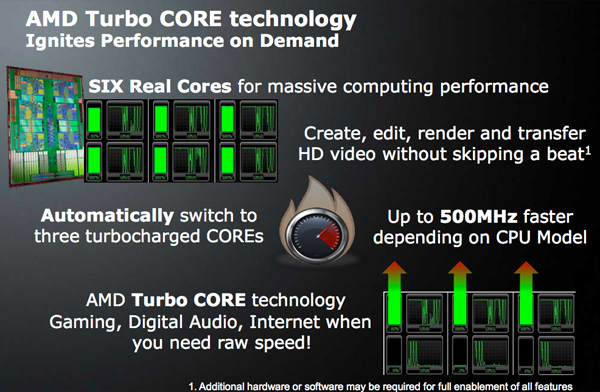
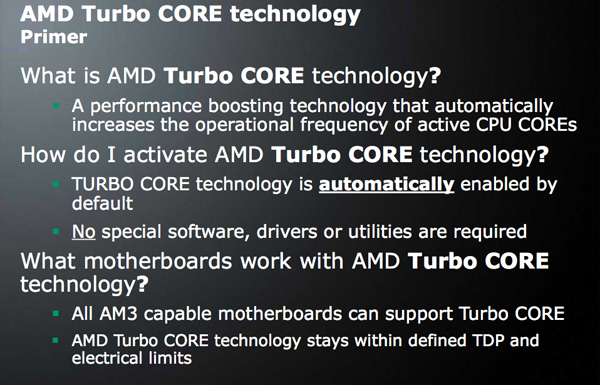
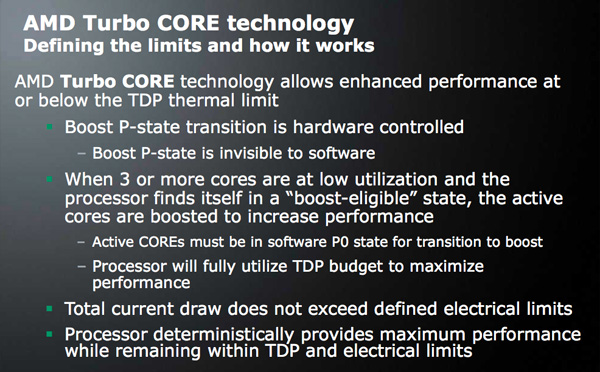
Turbo CORE tech in the Phenom II X6 can automatically add as much as 500MHz to the operating frequency of the CPU. Activating Turbo CORE requires that three of the six cores in the chip lie dormant, which naturally places the chip below its thermal design power (TDP) of 125W. If a chip is operating below its rated TDP, then there is spare current in the CPU socket and the processor isn’t at risk of overheating.
When the Phenom II X6 has heat and current to spare, the processor will reduce the clockspeed of the three idle cores to 800MHz, boost the voltage across the chip and then turbo the active cores by up to 500MHz. If the system’s workload suddenly requires the idle cores, then Turbo is removed and all six cores return to their rated frequencies.
This entire process is automated by what is essentially an extension to AMD’s Cool’n’Quiet technology, which has long enabled AMD CPUs to independently adjust the frequency of CPU cores when they’re not in use. Whereas, today, CnQ can only adjust the frequency downwards, the Phenom II X6’s power/frequency management techniques can now also identify opportunities where it’s acceptable to adjust the frequency upwards.
With respect to Intel’s Turbo Boost functionality, AMD’s implementation is a little more crude. For starters, Intel CPUs feature a technique called “power gating” that allows idle cores to shut down. AMD will not offer this technology until the 2011 introduction of the Lano APU. Additionally, AMD CPUs cannot independently adjust core voltages, adjust the turbo frequency based on thermal monitoring or adjust the turbo frequency based on the number of active cores.
Nevertheless, Turbo CORE is a welcome addition to the Phenom II family of processors that will no doubt please those who work daily with tasks that benefit from extra horsepower, but not necessarily extra cores. Games are a perfect example of this model. Turbo CORE is also an easy, inexpensive answer to Intel’s Turbo Boost, which has reached a marketing crescendo as of late with the introduction of the Core i5 series and the hexa core 980X CPU.
Performance
Performance, of course, is the big concern with any new CPU, but the situation is easy to address with just a few bullet points:
- In Photoshop, the Phenom II X6 CPUs generally fall to any Core i7 you can find.
- In video encoding, the 1090T is competitive with all Core i7s but the Extreme Edition chips, while the 1055 loses to most (though by a narrow margin).
- In 3D DCC, the results play out similarly to that of video encoding, provided that the application you’re using is able to leverage six cores.
- In gaming, both chips are generally within a stone’s throw of Intel’s offerings, but rarely take home a decisive win.
In short, if you know the Phenom II X4 to be slower than a Core i7 at your killer app(s), the X6 might narrow the gap, but will not close it. If you know the Phenom II X4 to be faster than the Core i7 in your killer app(s), the X6 might widen the gap, but won’t run away with the lead. After all, the X6 is virtually identical to the X4; no major architectural changes were made beyond Turbo CORE.
Before dispensing judgments, however, consider the following price and perspective sections, which we believe drastically alters the value of the X6.
Prices
890FX motherboards: Approximately $200 or higher (Available now)
Phenom II X6 1055: $199.99 MSRP (Available now)
Phenom II X6 1090T: $285.99 MSRP (Available for pre-order; shipping soon)
Perspective
The Phenom II X6’s value proposition is that it offers two more cores and a base frequency that’s equal to or higher than $270 Core i7 860. By any metric, we can see there’s some real price/performance value here, particularly for DCC folks already committed to socket AM3. The Phenom II X6 turns in results that are appreciably close to the Core i7 980X, a chip that’s roughly four times the price. The choice is yours: $300 for 85% of maximum, or $1000 for the whole enchilada.
For gamers, the upgrade case is far less convincing, as few games respond well to more than about three cores, meaning the 3.4GHz Phenom II X4 965 keeps its throne as AMD’s fastest gaming chip. It also means that the Core i7 860 is probably a better buy.
Expect Icrontic’s complete performance analysis of the Phenom II X6 and 890FX in the coming days, but these fine sites also have quality reviews to tide you over:
HardwareCanucks: Read (890FX)
AnandTech: Read
PC Perspective: Read
HotHardware: Read
X-bit labs: Read




 Articles RSS