


AMD has recently provided a slide deck that sheds new light on “Turbo CORE,” the company’s upcoming match to Intel’s Turbo Boost, both of which increase the clockspeed of active CPU cores when the thermals of the chip permit.
The new technology will be featured in AMD’s upcoming Phenom II X6 CPUs. Based on an extension of the basic Phenom II architecture, the Phenom II X6’s new Thuban design tacks on an additional two cores to bring the total number up to six. In addition to the Phenom II X6, AMD also intends to offer at least one quad core with Turbo CORE tech in a chip based on the Zosma core, a minor respin of today’s Phenom II X4.
Though the models and speeds behind the upcoming Thuban and Zosma lines have not officially been confirmed, the following table is quite likely to be accurate:
| Model | Frequency | Turbo | L3 Cache | TDP | Socket | Availability |
| Phenom II X6 1090T | 3.2GHz | 3.6GHz | 6MB | 125W | AM3 | Q2 |
| Phenom II X6 1075T | 3.0GHz | 3.5GHz | 6MB | 125W | AM3 | Q3 |
| Phenom II X6 1055T | 2.8GHz | 3.2GHz | 6MB | 125/95W | AM3 | Q2 |
| Phenom II X6 1035T | 2.6GHz | 3.1GHz | 6MB | 95W | AM3 | Q2 |
| Phenom II X4 960T | 3.0GHz | 3.4GHz | 6MB | 95W | AM3 | Q2 |
How does Turbo CORE work?
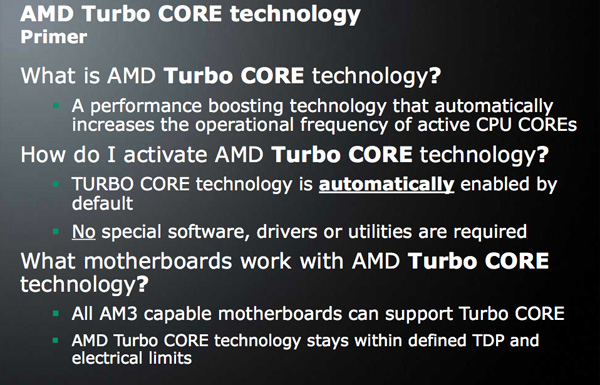
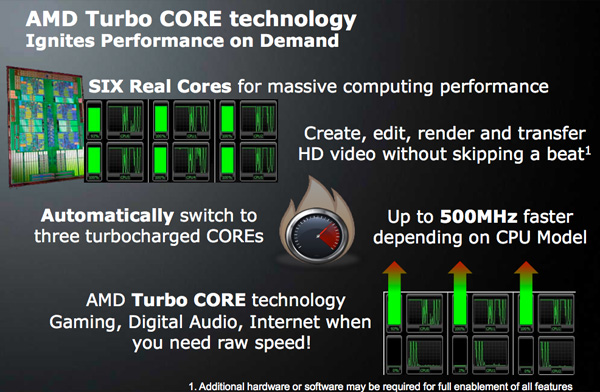
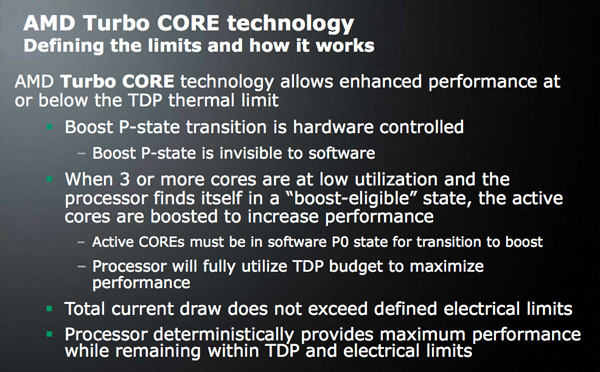
Turbo CORE in the Thuban and Zosma families can automatically add as much as 500MHz to the operating frequency of the CPU. Activating Turbo CORE requires that three of the six cores in a Phenom II X6 lie dormant, which naturally places the chip below its natural thermal design power (TDP) of 95W or 125W; if a chip is operating below its rated TDP, then there is spare current in the CPU socket, and the processor isn’t at risk of overheating.
When the Phenom II X6 has heat and current to spare, the chip will reduce the clockspeed of the three idle cores to 800MHz, boost the voltage across the chip, and then turbo the active cores by up to 500MHz. If the system’s workload suddenly requires the idle cores, then Turbo is removed and all six cores return to their rated frequencies.
This entire process is automated by what is essentially an extension to AMD’s Cool’n’Quiet technology, which has long enabled AMD CPUs to independently adjust the frequency of CPU cores when they’re not in use. Whereas, today, CnQ can only adjust the frequency downwards, Zosma and Thuban’s power/frequency management techniques can now also identify opportunities where it’s acceptable to adjust the frequency upwards.
With respect to Intel’s Turbo Boost functionality, AMD’s implementation is a little more crude. For starters, Intel CPUs feature a technique called “power gating” that allows idle cores to shut down. AMD will not offer this technology until the 2011 introduction of the Lano APU. Additionally, AMD CPUs cannot independently adjust core voltages, adjust the turbo frequency based on thermal monitoring or adjust the turbo frequency based on the number of active cores.
Nevertheless, Turbo CORE is a welcome addition to the Phenom II family of processors that will no doubt please those who work daily with tasks that benefit from extra horsepower, but not necessarily extra cores. Games are a perfect example of this model.
Turbo CORE is also an easy, inexpensive answer to Intel’s Turbo Boost, which has reached a marketing crescendo as of late with the introduction of the Core i5 series and the hexa core 980X CPU.
Prices of the new turbo-enabled Phenom IIs are not yet available, but a retail release is expected within short order, and those of you with AM2+/AM3 motherboards will be eligible for an upgrade with a BIOS update.




 Articles RSS